
There’s No Magic Key to Building a Jewelry Business

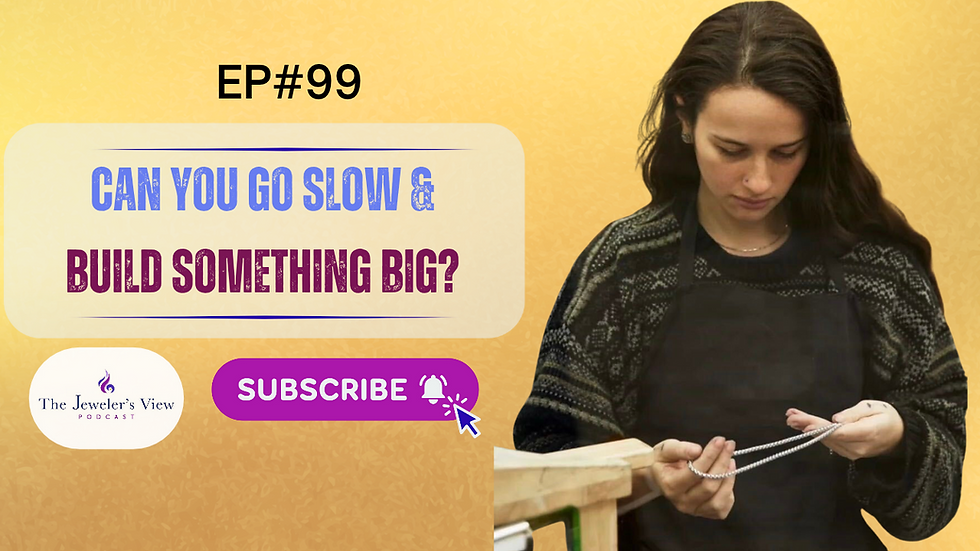
100 episodes ago, I sat down with a microphone, some ideas, and a plan so simple it barely deserves the word.
Begin. Make the first one. See what happens. Make another.
That was it. No master plan for 100 episodes. No guarantee of anything. I had experience in this industry, things I wanted to say, and a willingness to be uncomfortable on camera for the first few dozen times.
Here we are.
Here's what's really going on...
There is no magic key. And once you stop looking for it, something shifts.
1. What 100 Actually Looks Like
The Jeweler's View has now passed 15,000 audio downloads. We're averaging around 1,000 downloads a month. The YouTube channel has more than 17,000 views and over 200 subscribers.
I love sharing these numbers because they keep moving. But they're not the number I'm most proud of.
The number on the front of this episode is. 100.
Because I couldn't control how many people listened. I could control whether I made the next episode. Every week I did, something accumulated. Not because one episode went viral. Not because I found the formula. Because I kept coming back, 100 times.
That's the part worth celebrating.
2. The Treasure Chest on the Tom Petty Stage
Growing up in Houston, my family went to a lot of classic rock concerts.
One night we saw Tom Petty. He had this whole act built around a treasure chest on stage. He searched for the key, finally found the keyhole, turned it, and when the chest opened, an enormous white light poured out and filled the stage. The music started. It was fantastic.
Wouldn't it be nice if building a business worked that way? You search long enough, find the key, click, and light pours out everywhere. Your work starts selling. People show up at your bench offering thousands of dollars for whatever you just spent twelve hours sweating over. Cue the music.
Except that's not how this works.
There is no key. And I think that's actually freeing, once you let it land. Because if there's no secret key, you can stop looking for the thing you haven't found yet and start paying attention to what's already in front of you.
3. We Don't See the Hundredth Attempt
Look at almost anyone you consider successful and look past what you're seeing today.
Underneath it, there are hours, years, bad decisions, good decisions, things that flopped completely, things they had to learn, things they had to unlearn, times they got scrappy because they didn't have the money or resources they thought they needed. They stayed curious. They adjusted. They found another way. They gave it time.
We don't see that part. We see the finished photograph.
We don't see Tuesday afternoon three years earlier when nobody bought anything. We don't see the hundredth attempt. We don't see the day they wondered if any of it was actually working. And we don't get to see the first time they tried the thing they now make look easy.
I know that one firsthand.
When I started moving more of my work online, I was not comfortable on camera. I had to be coached through Zoom calls, taught where the buttons were, helped to hold space for a lot of people at once without falling apart. I taught my first pricing class and froze for the first ten minutes. Shaking. I stumbled through it and came out the other side.
The next one was a little easier. Then the next.
Now I host online events for more than five hundred people and think: okay, that was fun, I'm ready for more. Not because I stopped getting nervous. Because I've done it enough times to know that discomfort doesn't mean I'm doing the wrong thing. It means I'm doing something
I haven't learned how to do yet.
It gets easier. We don't say that enough.
4. Discomfort Is Not a Stop Sign
We try something once. It feels uncomfortable. And we decide: I'm just not good at that.
Of course you're not good at it yet. You just started.
You're allowed to stumble through the first one. You're allowed to feel awkward on camera. You're allowed to finish and immediately know ten things you'd do differently next time. That's not evidence that you shouldn't be doing it. That's how you learn to do it.
This podcast taught me the same thing. Episode one did not create what The Jeweler's View is today. Episode ten didn't either. There was no single episode where the treasure chest opened and everything changed. It accumulated, one episode at a time. I learned what I wanted to talk about. I learned what you needed to hear. I figured out what I didn't want the show to be. I changed things. I got frustrated. I got better. I came back the next week anyway. A hundred times.
5. Consistency With Attention
I want to be careful here, because consistency alone is not the answer.
Doing the same thing for ten years without paying attention is a very impressive rut. That's not what I'm describing.
What I mean is staying committed to the direction while being willing to change the route.
Noticing what's working and adjusting what isn't. Coming back after a month that didn't go the way you planned, not to repeat what failed, but to try a different angle.
You can't control whether someone buys your work this week. You can't control when the right opportunity appears. You can't force the timeline.
But you can learn. You can make. You can pay attention. You can get better. And you can come back.
6. The Question That Comes After "What Do I Want?"
For the last few weeks, we've been asking: what do you want? What doesn't fit? What are you trying to create?
Those questions matter. But eventually there's another one, and it's less fun.
Are you willing to stay with it long enough to find out what it can become?
Not forever. Not a thousand episodes. Just the next stretch. Long enough to teach you something. Long enough to get the reps. Long enough to make the mistakes and come out the other side knowing what you'd do differently.
That's the commitment that builds things. Not one giant flash of white light. One ordinary week at a time.
Apply It
Try this: Ask yourself the two-part question. What do I want? And am I willing to be uncomfortable long enough to get better at it? Write both answers down. Let the second one be honest.
Notice this: Where are you mistaking discomfort for a stop sign? Where have you tried something once, felt awkward, and concluded you're not good at it? That conclusion may be premature.
Start here: Commit to the next stretch, not forever. Pick the direction, give it enough time to teach you something, and come back after the hard weeks. That's how 100 gets made.
One day you might look up and realize you've made 100 of something. You've built a body of work. You've found your people. You've become better at what you do.
And you can trace the whole thing back to one fairly unremarkable day when you decided:
I'm going to begin.
That's worth celebrating.
Thank you for 100 episodes. Thank you for listening, for sharing these conversations, and for coming back. I'm here, cheering you on every single week.
Onward and upward. For the hundredth time.
If you're ready to build resilience, grow your creative business, and stay inspired, explore everything I offer from coaching and courses to workshops and The Jeweler's View podcast.
You don't have to do this alone.
Watch the Full Episode: https://youtu.be/qAf2uEYTrnQ
Listen here: https://www.buzzsprout.com/2413644/episodes/19901425


Comments